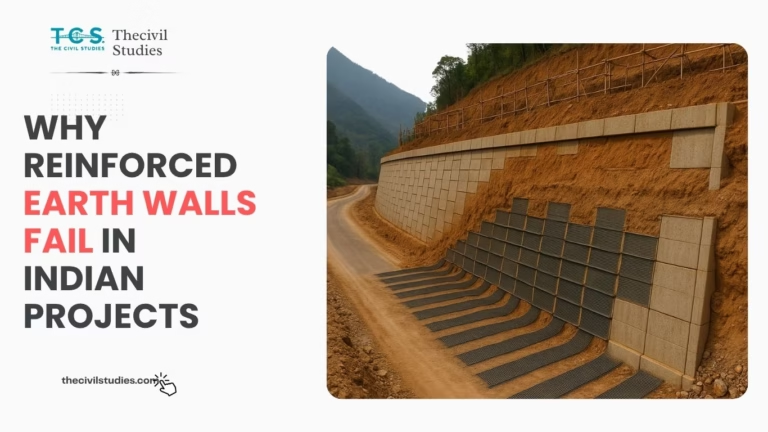
Cut slopes in hilly terrain become unstable once they are exposed during construction activities such as road widening, terrace formation, or hillside excavation. Without the natural confinement of surrounding soil or rock, the slope surface begins to weaken due to rainfall, seepage, weathering, and traffic-induced vibrations. This leads to raveling, localized failures, and falling debris—problems frequently seen on mountain roads across India, Nepal, Bhutan, and other high-rainfall regions.
To stabilize these exposed faces, engineers construct breast walls—a protective facing wall designed to confine the outer slope layer, control erosion, and ensure roadway safety. Breast walls are widely used in hill-road projects carried out by BRO, PWD, NHAI, MoRTH, and state rural engineering departments.
This complete guide explains the engineering logic, IS code references, material requirements, drainage design, construction sequence, failure causes, and field-level quality checks needed to build durable breast walls in real project conditions.
1. What Is a Breast Wall?

A breast wall is a low-height masonry or concrete wall built directly against a cut slope to prevent erosion, minor slips, raveling, and the fall of small debris. It stabilizes the surface layer of the slope rather than resisting large earth pressure like a retaining wall.
A well-built breast wall:
- Prevents slope debris from rolling onto the roadway
- Maintains the designed cut-slope profile
- Controls erosion due to rainfall and runoff
- Provides temporary/long-term face stability
- Enhances safety along hill highways
A breast wall supports only the surface layer, unlike a retaining wall which resists significant lateral earth pressure.
Key Functions
A well-designed breast wall:
- Maintains the geometric profile of the cut slope
- Restrains weathered and fractured material
- Reduces erosion caused by rainwater runoff
- Improves roadway safety by preventing falling debris
- Provides a stable face for long-term slope performance
- Which is One Property of Silt Soils? Retains Water, Drains Quickly, Has Coarse Particles, or Is Loose
- Soil Bearing Capacity: What It Is, Why It Matters & How Engineers Test It
- Reinforced Earth Retaining Walls: Causes of Failures, Design Guidelines & Construction Best Practices
- Retaining Walls: Complete Guide to Types, Construction Methods & Earth Retaining Structures
- How Civil Engineers Design Stormwater Drainage Systems to Handle Extreme Rainfall
- Excavation Terminology Every Engineer Must Knows – Toe Line, Cutting, and Filling Explained
IS Codes, MoRTH Guidelines & IRC Standards for Breast Wall Construction
Breast wall design and construction draw requirements from multiple Indian standards.
Relevant IS Codes
- IS 1597 (Part 1 & 2): Stone masonry construction
- IS 1121 & IS 1122: Testing of stones for strength and absorption
- IS 456: Concrete design (for RCC breast walls)
- IS 516: Testing concrete strength
- IS 1904: Foundation design in soils
- IS 3040: Drainage principles for retaining structures
MoRTH & IRC References (Hill Road Standards)
- MoRTH Section 2500: Specifications for retaining walls, breast walls & toe walls
- MoRTH Hill Road Specifications: Materials, drainage, stonework
- IRC:52-2019: Hill road alignment and construction
- IRC:SP:48: Hill road maintenance practices
- IRC:56 & IRC:75: Slope stabilization and retaining works
These documents guide:
- Minimum wall batter
- Weep hole spacing
- Stone quality tests
- Foundation depth
- Jointing and mortar specifications
- Drainage system requirements
Why Breast Walls Are Needed (Engineering Purpose)


Confinement of Weak or Weathered Slope Material
Hill slopes often consist of decomposed granite, weathered shale, or fractured rock. Cutting disturbs this layer, reducing stability.
A breast wall provides lateral confinement and prevents shallow failures.
Protection Against Surface Erosion
Rainfall and runoff rapidly wash away soil, forming gullies.
The breast wall protects the slope face from direct erosion.
Roadway Safety Enhancement
Loose stones and small slides pose hazards to vehicles.
A breast wall acts as a protective shield, preventing debris from reaching the roadway.
Drainage Management
By integrating weep holes and filter media, breast walls help release trapped water behind the slope—preventing hydrostatic pressure buildup.
Breast Wall Dimensions, Materials & Structural Reasoning

Dimensions vary depending on slope height, soil type, rainfall intensity, and traffic conditions.
Typical Dimensions
| Component | Standard Range | Engineering Purpose |
|---|---|---|
| Height | 1–3 m | For controlling surface instability |
| Base Thickness | 450–800 mm | Provides stability & bearing width |
| Top Thickness | 300–500 mm | Ensures structural continuity |
| Batter (Inclination) | 1:6 to 1:12 | Prevents overturning & adds stability |
| Foundation Depth | 300–600 mm (or to firm rock) | Ensures uniform load transfer |
Materials Used
- Dry rubble masonry: Good natural drainage but limited strength
- Cement rubble masonry: Most common; durable & stable
- RCC breast walls: Used where slope is highly fractured or saturated
Stone quality must follow IS 1121 / IS 1122 for compressive strength and water absorption.
Types of Breast Walls Used in Practice
Dry Rubble Masonry Breast Wall
- Suitable for small slopes
- Allows natural drainage
- Not ideal for high rainfall zones
Cement Mortar Rubble Masonry Breast Wall
- Most widely used in BRO/PWD projects
- Higher structural stability
- Long service life
Reinforced Concrete Breast Wall
- Used for weak, fractured, or highly erodible slopes
- Provides uniform structural support
Breast Wall with Filter Media & Weep Holes
- Essential in monsoon-prone areas
- Prevents hydrostatic pressure buildup
Stepped Breast Walls
- Used when the cut height is 4–6 m or more
- Multiple small walls with berms improve stability
Step-by-Step Construction Procedure (Practical Field Method)
Step 1: Slope Dressing
- Remove loose stones, roots, debris
- Trim slope to specified angle (60–70° typical)
- Identify seepage zones
Step 2: Foundation Preparation
- Excavate to firm ground or rock
- Level and compact foundation bed
- PCC leveling if bedrock is uneven
Step 3: Base Course
- Use largest stones
- Maintain required batter from first course
Step 4: Masonry Construction
- Provide headers projecting into the wall
- Through-stones at regular spacing
- Tight joints with properly filled mortar
- Avoid vertical alignment of joints
Step 5: Drainage Arrangement
Weep Holes
- Diameter: 75–100 mm
- Spacing: 1–1.5 m
- Slope: 1 in 20 outward
- Line with PVC/GI pipe
- Provide gravel filter to prevent blockage
Filter Media
- 25–75 mm graded gravel
- 150–300 mm thick layer behind wall
Step 6: Backfilling & Compaction
- Use granular backfill
- Compact in 200–250 mm layers
- Ensure surface runoff is diverted away from toe
Common Breast Wall Failures & Engineering Causes
| Failure Type | Cause |
|---|---|
| Bulging | Insufficient batter, weak masonry bonding |
| Tilting | Shallow foundation, weak soil |
| Cracking | Poor mortar quality or curing |
| Sliding | Water pressure buildup, inadequate drainage |
| Stone Dislodging | Lack of through-stones |
| Toe Erosion | Poor runoff management near base |
Failures peak during monsoon due to blocked weep holes or poor filter media.
Practical Quality Control Checklist for Engineers
| Category | Quality Control Requirements |
|---|---|
| Foundation | • Resting on firm soil or rock• Foundation bed level and properly compacted• Clean surface free from loose debris |
| Wall Construction | • Wall batter maintained uniformly• Through-stones provided at correct spacing• Mortar mix followed as per specification• Proper bonding between stones• No hollow joints or honeycombing |
| Drainage | • Weep holes properly aligned and open• Correct spacing of weep holes as per design• Filter media installed behind wall• Surface drains constructed to divert water |
| Backfilling | • Only granular material used• Backfill compacted in layers• No water stagnation near the toe of wall |
Summary (Quick Revision)
- Breast walls stabilize cut slopes in hill terrain
- Follow IS 1597, IS 1121/1122, IS 456 & MoRTH Section 2500
- Height: 1–3 m; Batter: 1:6 to 1:12
- Drainage is critical (weep holes + filter media)
- Failures mainly due to poor drainage or workmanship
- Proper bonding with through-stones is essential
FAQs – Frequently Asked Questions
What is the main purpose of a breast wall?
A breast wall prevents erosion, controls raveling, and stabilizes the surface layer of a cut slope in hilly terrain.
Which IS Code is used for breast wall construction?
There is no single code for breast walls, but IS 1597, IS 1121, IS 456, IS 1904, and MoRTH Section 2500 are commonly referenced.
Why are weep holes necessary in breast walls?
Weep holes relieve water pressure, prevent saturation behind the wall, and minimize the risk of bulging or sliding during monsoon.
How is a breast wall different from a retaining wall?
A breast wall supports only the surface layer of a cut slope, while a retaining wall resists significant lateral soil pressure from backfill.
What causes breast wall failure?
Typical causes include poor drainage, inadequate batter, weak mortar, absence of through stones, shallow foundation, and blocked weep holes.