


Quick Facts
- Location: Ahmedabad District, Gujarat (Approx. 100 km southwest of Ahmedabad)
- Area: ~920 sq. km
- Type: Greenfield Smart Industrial City
- Developer: DICDL (SPV of Govt. of India & Gujarat) under DSIRDA
- Corridor: Delhi-Mumbai Industrial Corridor (DMIC)
- Investment: ₹1 Lakh Crore+ (estimated, multi-phase)
- Target Population: 1–2 Million by 2040
- Special Status: Special Investment Region (SIR) under Gujarat Act, 2009
Most infrastructure projects in India work within constraints — they upgrade existing roads, add capacity to running systems, or retrofit ageing utilities. Dholera Smart City breaks that pattern entirely. Here, a fully planned urban environment is being constructed on previously undeveloped land — no legacy pipes to worry about, no existing street grids to compromise around, no inherited problems. Everything — from road geometry to fibre optic routing — is being designed at once, as a system.
For civil engineers, this is an extraordinarily rare opportunity to study how modern urban infrastructure theory actually translates into construction on the ground. The project also carries enormous national weight: it is India’s single largest greenfield smart city, positioned as a testbed for what 21st-century urban planning can look like in a developing economy context.
This article walks through the engineering architecture of Dholera Smart City — its planning logic, infrastructure systems, construction phasing, and the very real challenges that complicate what looks clean on a master plan.
What is Dholera Smart City?
Dholera is a Special Investment Region (SIR) located approximately 100 km southwest of Ahmedabad, in the Gulf of Khambhat coastal zone of Gujarat. It sits directly along the Delhi–Mumbai Industrial Corridor (DMIC) — a 1,500 km freight and industrial spine that is India’s most ambitious economic corridor project.
The city is being developed under the Dholera Special Investment Region Development Authority (DSIRDA), a dedicated government body set up under Gujarat’s SIR Act. Unlike retrofit smart city projects under the Smart Cities Mission, Dholera is a true greenfield development — meaning every square metre of urban land is being designed and built to a common master plan, without the friction of an existing city to negotiate with.
The city covers 920 sq km — roughly 1.5 times the size of Mumbai’s municipal area. Its scale puts it in a class of its own within India’s urban planning history.
Master Planning and Urban Layout
Land Pooling: The Foundation of the Entire Project
Before a single road could be engineered, Dholera had to solve a foundational problem: how do you assemble 920 sq km of land spread across dozens of villages, held by thousands of small landowners, into a single developable zone?
Gujarat’s answer was the Town Planning (TP) Scheme mechanism — a land readjustment model inspired by international practices such as those used in Japan and Taiwan. Under this system, landowners surrender their original irregular plots in exchange for smaller but serviced and development-ready “reconstituted plots” within the scheme area. The government retains a portion of land from each owner to finance roads, parks, utilities, and public infrastructure.

Engineering Insight
The TP Scheme is not just a legal mechanism — it is a spatial engineering tool. It allows planners to geometrically regularise irregular landholdings into a planned grid without requiring outright acquisition. This significantly reduces the legal challenges that often affect large infrastructure projects.
Zoning and Land Use Framework
Dholera’s master plan, prepared jointly by DSIRDA with support from international consultants such as AECOM, establishes a mixed-use zoning framework with clearly delineated districts:
- Industrial Zones: Heavy manufacturing, logistics parks, and processing industries, planned along the main freight corridor with large plot sizes ranging from a few hectares to several tens of hectares and dedicated heavy vehicle access roads.
- Residential Zones: Mixed-density housing from affordable units to high-end developments, planned around neighbourhood-level services within walking distance.
- Commercial and Business Districts: Central Business District (CBD), SEZ areas, and retail corridors with FAR provisions accommodating high-rise development.
- Knowledge and Innovation Zones: Land earmarked for educational institutions, R&D facilities, and technology parks.
- Green and Recreational Buffers: Approximately 20–22% of the total area reserved as open space and green zones — a significantly higher green ratio than most Indian cities.

Core Infrastructure Development: An Engineering Deep-Dive
1. Road Network Design
Dholera’s road hierarchy is one of its most technically sophisticated elements. The network follows a modified grid pattern with a clear hierarchical classification:
- Expressway/Arterial (60–100m ROW): The spine roads, including the Dholera-SIR Expressway connecting to Ahmedabad. These corridors carry freight and inter-city movement and are designed for speeds of up to 80–100 km/h (design-dependent).
- Sub-Arterial Roads (30–45m ROW): District-level connectors, typically 4-lane undivided or 6-lane divided carriageways, designed for moderate urban speeds (~50–60 km/h).
- Collector Roads (18–24m ROW): Neighbourhood access roads linking residential and commercial plots to the sub-arterial network.
- Local Streets (12–15m ROW): Slow-speed internal circulation, accommodating pedestrians, cyclists, and slow-moving vehicles.
A critical design feature is the utility corridor integration within the road right-of-way. All underground utilities — water mains, sewer lines, power cables, telecom ducts — are pre-planned within designated trenches alongside road footpaths, allowing future maintenance without road cutting. This is the plug-and-play philosophy in practice.
2. Water Supply System
The water supply system design is a significant engineering challenge, given Dholera’s coastal proximity and the lack of perennial surface water sources nearby.
- Source: The primary water source is the Narmada canal network via the Saurashtra Branch Canal. Bulk water is drawn and transported through a dedicated raw water transmission system to treatment facilities.
- Treatment: A centralised Water Treatment Plant (WTP) with an initial capacity of ~80–90 MLD (expandable in future phases) uses a conventional treatment train: flash mixing, flocculation, sedimentation, rapid sand filtration, and chlorination. Advanced treatment methods may be incorporated for specific potable requirements.
- Distribution: A pressurised zonal distribution system (ZDS) divides the city into District Metered Areas (DMAs) — a design approach that improves leak detection, pressure management, and demand monitoring compared to conventional systems.
- Smart Metering: Automated Meter Reading (AMR) infrastructure is embedded into the distribution design, enabling real-time consumption tracking and non-revenue water (NRW) management from day one.
3. Sewerage and Drainage System
One of the most complex underground systems in Dholera’s infrastructure package, the sewerage design adopts a separate system approach — stormwater and wastewater are carried in entirely separate pipe networks. This is in sharp contrast to many older Indian cities that use combined sewers, which are a significant cause of urban flooding and sewage overflow during monsoon.
- Wastewater Collection: Gravity-based sewer mains, with depths varying from 1.5m to 6m depending on local topography. The flat coastal terrain requires careful hydraulic gradient design to maintain self-cleansing velocities (typically around 0.6 m/s, design-dependent).
- Sewage Treatment Plants (STPs): Decentralised STPs are planned at district level, treating sewage to tertiary standards. Treated wastewater is earmarked for industrial reuse and landscape irrigation — reducing fresh water demand.
- Stormwater Drainage: The city adopts a dual drainage strategy: a minor drainage network (underground box culverts and pipe drains) handles frequent rainfall, while a major drainage network (natural and engineered channels) manages high-intensity storm events and reduces flood risk.
Engineering Note: Flat Terrain Challenge
Dholera’s coastal plain has extremely low natural gradient — in some areas, less than 1:2000. This creates a fundamental sewerage design challenge: maintaining adequate flow without excessive pumping. The engineering solution involves careful micro-grading of the entire city platform during development, raising finished ground levels by 0.5–2m to create workable drainage gradients. This earthwork alone represents one of the largest volume civil works in the project.
4. Power Infrastructure
Dholera’s power distribution strategy breaks decisively from the overhead line standard prevalent in most Indian cities.
- Underground Cabling: The entire internal distribution network uses High Voltage Distribution System (HVDS) cables laid underground. This eliminates the visual clutter of overhead lines, dramatically reduces distribution losses (from the national average of 20–25% down to a target of under 10%), and eliminates outages from weather events and animal interference.
- Smart Grid Integration: The power network is designed with SCADA-based grid management from the outset — smart meters, automated fault isolation, load balancing, and demand response systems are embedded infrastructure, not retrofits.
- Substations: A cascade of 400kV, 220kV, and 66kV substations feeds the city’s internal 33kV and 11kV distribution network.
- Renewable Integration: Dholera is connected to the state’s large-scale solar generation capacity in the region. On-site solar mandates and provision for rooftop solar interconnection are built into the grid design.
5. ICT and Smart Systems
The “smart” in Dholera Smart City is anchored by a physical ICT layer that most cities attempt to add onto existing infrastructure but that Dholera is building in from the start.
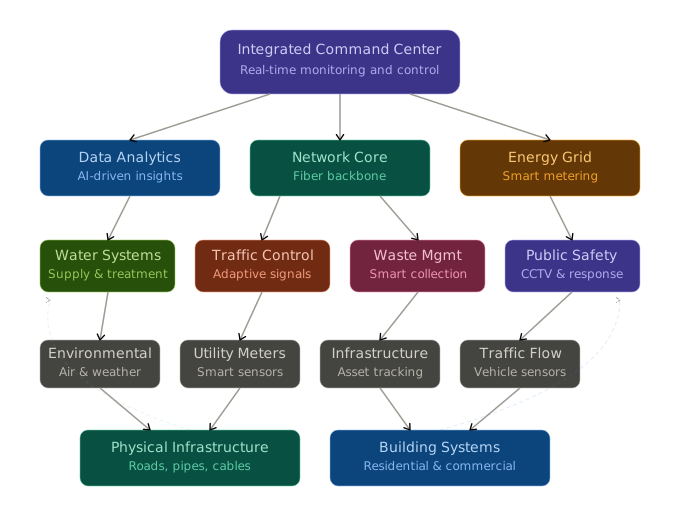
- Integrated Command and Control Centre (ICCC): A centralised operations facility monitoring utility performance, traffic management, emergency response, and environmental sensors across the city. Modelled on similar facilities in Songdo (South Korea) and Masdar (UAE).
- Fibre Optic Backbone: City-wide underground fibre optic ducts, with conduit networks pre-installed within road corridors to allow dark fibre to be pulled in as demand grows — a future-proof approach that avoids repeated digging.
- Sensor Networks: Environmental monitoring stations, flood sensors, traffic counters, and utility telemetry points are distributed throughout the city, feeding real-time data to the ICCC.
- Public Wi-Fi Infrastructure: Duct and mounting provisions for city-wide wireless access points, integrated into street furniture and light poles.
Sustainability and Smart Features
Dholera’s sustainability framework goes beyond token green buildings. Several city-system-level commitments distinguish it from conventional development:
- Solar Energy: Gujarat’s status as India’s solar leader is leveraged through the Dholera Solar Park — one of the largest solar installations being developed adjacent to the city. The goal is to achieve 100% renewable electricity for the city’s common area infrastructure within the first decade.
- Green Infrastructure: Designated green buffers along drainage channels, tree-lined roads with minimum canopy targets per km, and neighbourhood parks within 500m walking distance of all residential plots — enforced through development control regulations, not just plans.
- Waste Management: A door-to-door collection system, dry/wet waste segregation at source, decentralised composting facilities, and a regional solid waste processing plant combining mechanical biological treatment (MBT) with a waste-to-energy component. Zero landfill is the stated long-term target.
- Water Recycling: Treated wastewater recycling for industrial cooling, park irrigation, and road cleaning — reducing fresh water demand per capita by an estimated 25–30% compared to a conventional city of similar scale.
Construction Strategy: How You Build a City From Zero
Perhaps the most instructive aspect of Dholera for civil engineering students is not what is being built, but how it is being sequenced.
Phase-Wise Development
Dholera’s 920 sq km total area is developed in phases, with an initial Activation Area of approximately 22.5 sq km within Phase 1 receiving the earliest infrastructure investment. This approach — sometimes called a “lighthouse area” strategy — concentrates development to create a critical mass of working infrastructure before expanding outward.
| Phase | Area | Primary Focus | Target Period | Status (2025) |
|---|---|---|---|---|
| Phase 1A (Activation Area) | 22.5 sq km | Trunk infrastructure, industrial plots, anchor institutions | 2020–2026 | In Progress |
| Phase 1B | ~100 sq km | Residential, commercial, knowledge zone | 2026–2030 | Planned |
| Phase 2–6 | Remaining ~800 sq km | Full city buildout, industrial expansion | 2030–2045 | Long-term |
The Plug-and-Play Infrastructure Philosophy
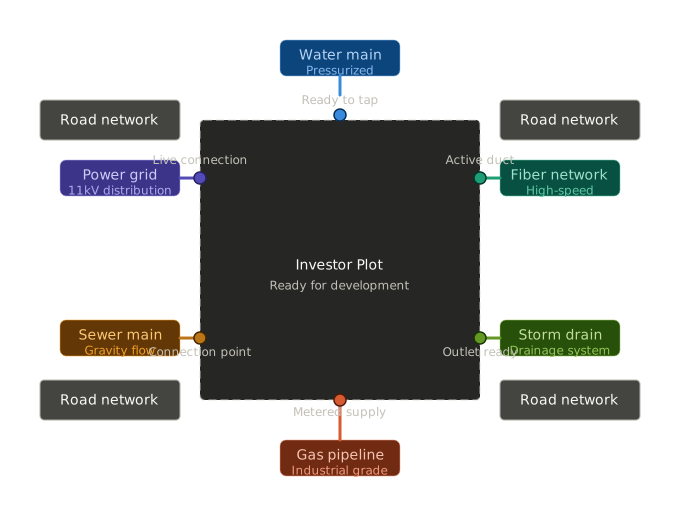
Dholera’s design team adopted a principle common in industrial park development but rarely applied at city scale: all trunk infrastructure is installed before individual plot development begins. Roads, water mains, sewer connections, power distribution cables, and fibre ducts are brought to each plot boundary before any building is constructed. When an investor takes possession of a plot, they find a live, functional connection point at the boundary — not a raw field with infrastructure years away.
This model — borrowed from successful SEZs like Jamshedpur and international examples like Jebel Ali — dramatically reduces the time between investment decision and operations commencement, making it significantly more attractive for manufacturers with tight project timelines.
Latest Progress and Current Status (2025–2026)
As of mid-2025, Dholera’s activation area infrastructure has reached a meaningful stage of development, although full-scale urban functionality is still evolving. The current status reflects a mix of completed trunk infrastructure and ongoing system-level integration.
Completed / Substantially Advanced
- Ahmedabad–Dholera Expressway — under development, with connectivity improving in phases
- Phase 1 trunk road network within the activation area — substantially complete
- Water Treatment Plant (Phase 1 capacity: ~80–90 MLD) — commissioned
- Underground power cabling in activation zone — partially completed
- Land pooling and TP Scheme finalisation for Phase 1 — completed
Under Construction / Active Development
- Sewer network installation across multiple sectors
- Stormwater drainage network and channel engineering
- Integrated Command and Control Centre (ICCC) — system integration and fit-out
- Industrial plot development by early-stage investors (electronics, advanced manufacturing)
- Residential plotted development by GIDC in select zones
The Tata Electronics semiconductor manufacturing facility, with an investment of approximately ₹91,000 crore, has been approved and is under development in Dholera. This represents one of the most significant private-sector commitments to the project and reinforces its positioning as a future electronics and semiconductor hub.
Economic and Industrial Impact
Dholera’s economic logic is deeply tied to its infrastructure-first planning approach. Unlike conventional urban expansion, the city is being developed primarily as an industrial ecosystem, with residential and commercial components supporting production-oriented growth.
- Semiconductor and Electronics:
Under India’s semiconductor policy, Dholera has been positioned as a key manufacturing destination. The Tata Electronics facility marks the early formation of a potential semiconductor cluster. - Defence and Aerospace:
Large industrial plots, proximity to the upcoming airport, and strong regional connectivity make Dholera suitable for defence production and MRO (maintenance, repair, overhaul) operations. - Logistics and Warehousing:
Its location within the Delhi-Mumbai Industrial Corridor (DMIC) and proximity to the Dedicated Freight Corridor (DFC) provide a strong foundation for multimodal logistics development. - Employment Potential:
Long-term projections indicate the potential for up to ~800,000 jobs, with additional indirect employment generated through supply chains and supporting industries.
Challenges and Ground Reality
Any realistic engineering assessment of Dholera must consider structural challenges that influence the pace and outcome of development. These are not isolated issues but systemic characteristics of large-scale greenfield infrastructure projects.
1. The Occupancy–Infrastructure Paradox
Infrastructure systems such as water supply, power distribution, and transport networks require a minimum level of utilisation to be economically viable. However, industries and residents are more likely to move in only after these systems are fully operational. This creates a feedback loop that slows early-stage growth.
2. Land Pooling and Stakeholder Resistance
While the TP Scheme mechanism reduces the need for compulsory land acquisition, implementation has faced resistance in certain areas. Concerns over land value, future uncertainty, and transition from agricultural to urban land use have led to delays in some sectors.
3. Execution Timeline Variations
Initial projections from the early 2010s anticipated faster development. However, as of 2025, infrastructure development is still ongoing across multiple components. This aligns with global trends—large greenfield cities such as Songdo (South Korea) have taken decades to achieve stable occupancy levels.
4. Financial and Viability Constraints
Developing infrastructure across even the 22.5 sq km activation area requires significant capital investment. The financial model depends on a combination of government support, land monetisation, and private investment. Slower-than-expected investor inflow can impact both financial planning and project phasing.
Why This Project Matters for Civil Engineers
Dholera represents a rare, real-world case study of integrated infrastructure planning at scale.
- Systems Integration:
Coordination of water, sewerage, power, transport, and ICT systems within a unified planning framework. - Phased Infrastructure Delivery:
Strategic sequencing of infrastructure investments in anticipation of future demand. - Greenfield vs Brownfield Design Thinking:
Understanding the opportunities and constraints of building from scratch versus upgrading existing cities. - Socio-Political Interface:
Recognising how land policies, governance, and stakeholder engagement directly affect engineering outcomes.
From a career perspective, expertise in smart infrastructure systems, DMA-based water networks, underground utility coordination, and digitally managed infrastructure will be increasingly valuable in projects like Dholera.
What Dholera Actually Tells Us About India’s Infrastructure Future
Dholera is neither a perfect success nor a failed experiment—it is an evolving, large-scale test of whether India can deliver integrated, future-ready urban infrastructure from the ground up.
The engineering ambition is real. The planning systems—underground utilities, smart grids, zonal water distribution, and plug-and-play industrial infrastructure—reflect a significant shift from traditional urban development models.
However, the deeper challenge lies beyond engineering. Infrastructure can be designed and built, but cities require time to develop social, economic, and cultural ecosystems. The gap between planned infrastructure and lived urban reality is where Dholera’s long-term success will be determined.
For the civil engineering community, Dholera will remain one of the most important reference projects in India—offering lessons not just in design and execution, but in the complex relationship between infrastructure, policy, and human settlement.
Frequently Asked Questions (FAQ)
What is the current status of Dholera Smart City in 2025?
As of 2025, Dholera’s Phase 1 activation area (22.5 sq km) has seen substantial trunk infrastructure completion including the expressway, WTP, and internal road network. The DSIR airport is in final stages. Industrial investor activity has accelerated significantly, anchored by the Tata Electronics semiconductor plant announcement. However, full occupancy is still years away.
How is Dholera Smart City different from the Smart Cities Mission projects?
Dholera is a Greenfield Special Investment Region — built on undeveloped land with all infrastructure installed from scratch. The Smart Cities Mission, by contrast, upgrades existing cities with technology and infrastructure improvements. Dholera has no existing city constraints, allowing full-system integration from the design stage. It is also significantly larger and driven primarily by industrial development logic.
What are the main infrastructure challenges in building Dholera’s drainage system?
The primary challenge is Dholera’s extremely flat coastal terrain with minimal natural drainage gradient (in some areas less than 1:2000). Engineers are addressing this through micro-grading of the entire city platform — raising finished ground levels by 0.5–2m to create workable drainage slopes. A dual drainage system (minor and major networks) handles both frequent low-intensity rainfall and extreme storm events, keeping the city flood-resilient over a wide range of weather conditions.


